
Select your language


Abolishing the prostitution system : a trade union responsibility
25 September 2026
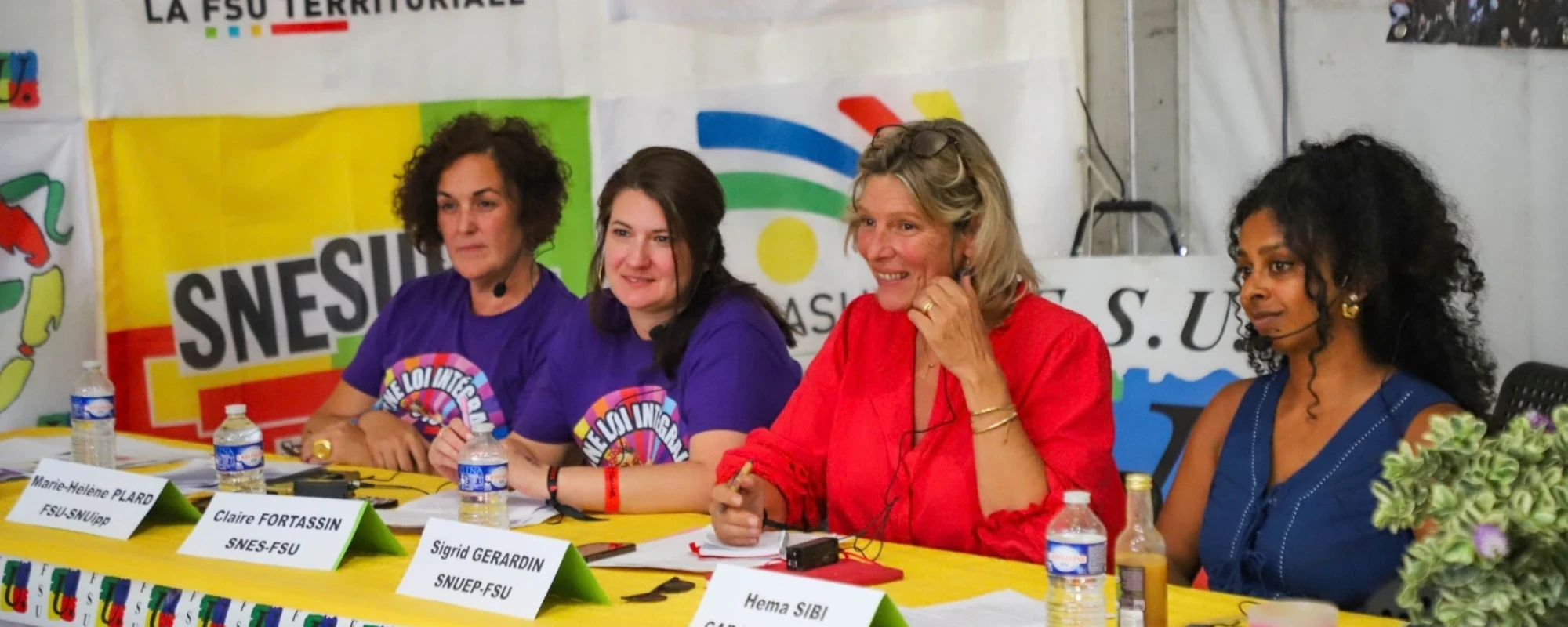
This September, CAP international was present at the Fête de l’Humanité in France. Alongside the Fédération Syndicale Unitaire (FSU), the coalition took part in a panel discussion entitled “Breaking the prostitution system and combating sexual exploitation: a trade union responsibility”. Claire Fortassin, from the French trade union NUEP- FSU, notably questioned the place of work, consent and relations of domination within the prostitution system. Find her presentation below.
Abolishing the prostitution system: a trade union responsibility
I would like to start with a very simple question: why should a trade union organisation such as the FSU take a position on prostitution?
At first sight, prostitution seems quite far removed from our field of action. But in reality, it raises deeply trade-union questions. What is work? What do we accept as falling within the scope of the market? And what does free choice really mean when that choice is exercised in a society shaped by class and gender relations of domination? And ultimately, what are we seeking to defend when we defend women and men workers?
The FSU’s position is abolitionist. And being abolitionist obviously does not mean condemning people in prostitution. It is quite the opposite. The abolitionist model we defend decriminalises people in prostitution, combats pimping and trafficking networks, penalises sex buyers who purchase sexual acts, and demands that the public authorities provide people who want to leave prostitution with the material means to do so.
This is an essential point: people in prostitution are not the problem. The problem is the prostitution system. It is those who organise it and those who fuel demand by purchasing sexual access to another person’s body. This is the logic behind the French law of 13 April 2016: combating pimping and trafficking, protecting and supporting victims, enabling exit pathways and penalising the purchase of sexual acts. For the FSU, this law must be defended, but above all genuinely implemented and provided with the necessary resources.
The question of words: “sex work”
I would like to start with the question of words, because it is far from being secondary. For several years, an ideological offensive has sought to gradually replace the terms “prostitution” and “prostitution system” with “sex work” and “sex workers”.
This change in vocabulary is not insignificant. Speaking of “sex work” already gives prostitution a political and social qualification. It largely amounts to settling the debate before it has even begun. Work is an activity that produces goods or services, which can take the form of employment, give rise to remuneration and provide access to rights. And a profession implies skills, qualifications, something that can be learned and organised professionally.
So, if prostitution is a profession, we have to follow the reasoning through to its conclusion. The purchase of a sexual act becomes consumption like any other. We have to accept that there can be businesses organising this activity, intermediaries making a profit from it, and even employers recruiting people to carry it out.
And we have to go even further: if it really is a profession, should we create training courses? Define skills? Train people to perform sexual acts in response to a client’s demand? These are very concrete questions. And precisely because of this, the seemingly neutral vocabulary of “sex work” tends to make them disappear.
This is precisely what we reject at the FSU. In September 2024, together with the CGT, CFDT and Solidaires, we reaffirmed that prostitution “must under no circumstances be recognised as work”.
And this refusal is obviously not based on a moral judgement of people in prostitution. It follows from our understanding of work, our analysis of relations of domination and our understanding of trade unionism.
Not everything that provides an income is necessarily work.
We are regularly confronted with an argument: ultimately, anyone who works is selling something of themselves. A woman worker sells her labour power, a teacher her skills, a person in prostitution a sexual service. So why make a distinction? This argument may appear materialist.
But it is only apparently so. Because the entire history of the workers’ movement consists precisely in winning rights to protect women and men workers and collectively defining what a working relationship can, or cannot, permit.
Of course work involves the body. Take a care giver. She lifts patients, works standing up, sometimes at night, repeats movements, bends down, gets back up, and may finish her career with a body deeply damaged by her work.
But she does not sell her body. She performs a job, draws on qualifications and carries out professional tasks.
And the patient never acquires, simply because they benefit from her work, a right over her body.
In response to the harm that work causes her, our trade union response is precisely to seek to reduce it: through better working conditions, prevention and recognition of arduous working conditions.
This is therefore an important point of reference: we must not confuse the body involved in work with access to the body as the object of a transaction.
More broadly, employment law was built against the idea that a contract would be sufficient to make any economic relationship legitimate. We banned child labour. We limited working hours. We imposed health and safety standards. Why? Because the existence of payment and contractual consent is not enough to make relations of domination disappear.
Indeed, this is one of the reasons trade unionism exists: to bring the social balance of power back into the picture behind the fiction of two perfectly free and equal individuals entering into a contract.
Yet this is precisely what the vocabulary of “sexual services” tends to erase. The sex buyer is not purchasing just any service. They are purchasing sexual access to another person’s body. And it is precisely the nature of what is being purchased that must be politically questioned.
As feminists and trade unionists, we have fought to have it recognised that a relationship of subordination or economic dependence never gives anyone a right to sexual access to a woman worker’s body. It would therefore be deeply contradictory to consider that this economic power, which we oppose everywhere else, could become the very principle of a professional activity.
The individual choice argument
A second argument is regularly put to us: individual choice. And this one must be taken seriously.
Yes, some adults say that they have chosen prostitution and define themselves as sex workers. We have no reason to deny their individual account.
But a trade union organisation does not construct its political analysis solely from situations in which relations of domination are least visible. It looks at structures. It looks at the material conditions in which choices are exercised. And it looks at power relations.
Yet the reality of the prostitution system reminds us of something essential: it is profoundly gendered and shaped by relations of domination. It is overwhelmingly men who purchase sexual acts. And it is overwhelmingly women and girls, sometimes minors, who are in prostitution.
Economic insecurity, migration, violence and social vulnerabilities play a central role in it. We therefore cannot reason as if we were simply dealing with two abstract individuals who are free and equal.
And once again, our trade union experience gives us tools. An employee may perfectly well say: “I want to work sixty hours a week.” That does not lead us to demand the abolition of maximum working hours. A person may agree to work for an extremely low wage. We do not infer from this that the minimum wage should be abolished.
Why? Because collective rights exist precisely to prevent economic necessity or individual bargaining power from alone determining the conditions under which we can exercise control over ourselves.
Individual consent exists. But it is always exercised under determined social conditions. So, the trade union question is not : can we find a person who says that they freely chose prostitution? Of course we can.
The real question is: what system do we want to establish for society as a whole? And what social realities does this market exploit?
When women are predominantly in prostitution and men are predominantly the buyers, we cannot pretend that gender magically disappears at the moment of the transaction. And when precarity, migration, violence and discrimination structure the prostitution system, we cannot isolate the monetary exchange from everything that made it possible.
For a trade unionism committed to social transformation, freedom does not simply mean being able to choose between the possibilities left to us by necessity. It also means transforming the material conditions that determine those choices.
“Regulation would make it possible to provide rights”
This is probably the argument that should concern us most as trade unionists. Because it uses our own language: social rights, protection, safety, health.
And of course people in prostitution must have rights. They must have access to healthcare, social protection, housing, papers, justice, safety and resources enabling them to live. They must be protected from violence and be able to access training and employment. And anyone who wants to leave prostitution must be materially able to do so.
But having rights does not require recognising prostitution as a profession. That is precisely the whole point of our position: protecting people without legitimising the market that organises their exploitation.
Because recognising prostitution as work does not only give people in prostitution a status. It also recognises as legitimate those who purchase sexual acts, those who organise this activity and those who profit from it. It gives economic and social existence to an entire market that we are precisely seeking to combat.
But we must be demanding of our own position: our abolitionism only makes sense if it genuinely provides the means to leave prostitution. This is where our trade union responsibility is essential: defending adequately funded exit pathways, but also access to housing, papers, training, employment and resources enabling people to live.
In other words: creating the material conditions so that prostitution is not an economic necessity.
Putting the sex buyer back at the centre
There is then something that seems essential to me in this debate. The discourse on “sex work” carries out an extremely effective political operation: it concentrates all attention on the person in prostitution.
Their choice. Their consent. Their autonomy. Their freedom.
And meanwhile, one character almost completely disappears: the sex buyer.
Yet there would be no prostitution system without demand. Without men who consider that their economic power can give them sexual access to another person’s body. We therefore need to turn the question around.
Why do we consider it acceptable for a man to purchase sexual access to another person’s body? And why should society recognise and organise this market?
This is precisely what the 2016 law challenges by penalising sex buyers: the idea that purchasing a sexual act would be a socially neutral behaviour. The sex buyer is not outside the prostitution system. They are a condition of its existence.
And this demand is overwhelmingly male. We are therefore not dealing with an abstract market between equal individuals: the prostitution system is profoundly structured by social relations of sex and gender.
These relations are embedded in a society in which women continue to earn less, are more exposed to precarity, violence and discrimination, and still assume a disproportionate share of domestic and parental work.
This is where class and patriarchy intersect. Economic inequalities allow some people to purchase sexual access to the bodies of others. This is why the debate cannot be reduced to the choice of the person in prostitution. We must put the sex buyer, money and social relations of sex and gender at the centre.
And the sexual freedom that we defend as feminists is the free disposition of one’s own body. It cannot become, for those who have the means, the freedom to purchase access to another person’s body.
Prostitution is also a question of class domination
And this is probably where our trade union responsibility is most important.
Let us ask a very concrete question: if we collectively decide that prostitution is a job like any other, who will take these jobs?
Our daughters? Women with degrees from privileged social classes?
Or, as in so many overexploited sectors, the poorest women, migrant women, those with the fewest resources and the fewest alternatives?
This question is disturbing because it reveals what the discourse on “free choice” tends to erase: class relations.
As trade unionists, we know that choices are not exercised independently of people’s material living conditions. Having an income, housing, papers, social protection, access to training and employment means having more choices.
This is why abolishing the prostitution system is inseparable from all our social demands. This is where the abolitionist struggle directly meets the trade union struggle. We are a federation of trade unions committed to struggle and social transformation. Our role is not simply to acknowledge existing economic relations and try to make them slightly less violent. We fight for wages, social protection, public services and equality in employment because we know that real freedom requires rights and economic autonomy.
This is exactly the same analytical framework that we must apply to prostitution.
Our response to women’s poverty cannot be to expand what they can sell. Our response to the precarity of foreign women cannot be to organise a market in which their vulnerability becomes an economic resource.
Our response to inequalities between women and men cannot be to turn the economic power of some into a right of sexual access to the bodies of others.
This is why abolishing the prostitution system is fully a question of class.
The supposed modernity of pro-sex-work arguments is an illusion
I would like to end with one final idea, because it runs through many debates on prostitution: on one side there would be a modern, progressive position, namely recognition of “sex work”, and on the other an abolitionism that is necessarily moralistic, paternalistic or even reactionary.
I think this opposition really needs to be challenged. And current events in fact provide a fairly illuminating example: in France, it is currently the Rassemblement national that is advocating reopening places of prostitution.
This is not insignificant. It shows at least one thing: recognising a prostitution market is not intrinsically progressive. The far right can perfectly well adopt the language of protection, safety, autonomy or access to rights to defend, behind these words, a deeply conservative conception of relations between women and men.
Because what is never questioned within this logic is male demand. It is assumed to exist, that it will always exist, that fighting it would be futile and that a market should therefore be organised to meet it. And consequently, the sexual availability of certain women should be organised. For me, this is precisely where the debate needs to be turned around.
What is progressive about considering it unavoidable that men purchase sexual access to women’s bodies? What is emancipatory about responding to economic and social inequalities by organising a market that allows those with money to purchase this access?
Presenting this commodification as an individual choice or as the exercise of a freedom is not enough to make the social relationship disappear. We must always return to ultimately very simple questions: who has the money? Who buys? Who is bought? Who organises the market? And who profits from it?
This is also why we reject the idea that abolitionism is a position from the past.
Our trade unionism committed to social transformation therefore does not consist in considering that every existing market should be recognised, organised and regulated. We oppose capitalism and its logic of commodification, which profits from inequalities and relations of domination and continually expands the field of what can be bought and sold.
And we combat with the same determination the far right, fascism and their reactionary projects, which seek to put women back in their place, attack the rights of women and LGBTQIA+ people, and defend a social order based on hierarchy, inequalities and domination.
It is therefore no coincidence that our abolitionist struggle intersects with our feminist struggle, our fight against capitalism and our fight against the far right. These struggles are part of the same project of social transformation: refusing to naturalise relations of domination, refusing to turn them into markets and combating the social relations that produce them.
Not everything is for sale. And emancipation does not consist in endlessly expanding the field of what women can sell.
It consists in winning the rights and material conditions of our freedom and radically transforming the society that produces these inequalities and relations of domination.
Conclusion
We can defend the rights, safety and dignity of people in prostitution while combating the prostitution system. There is no contradiction in this.
We can listen to those who define themselves as "sex workers” without considering that their individual experience alone should determine our political analysis.
Because our trade union horizon has never been to make exploitation more acceptable. It is to combat the social relations that produce it.
That is the whole meaning of our abolitionism: an abolitionism rooted in class struggle, feminism and social transformation.
The emancipation of women workers and women does not consist in expanding the field of what they can sell. It consists in collectively winning the rights and material conditions that make it possible not to have to do so.
This is why our abolitionism is feminist. And this is why it is fully rooted in trade unionism.
Claire Fortassin, FSU-SNUEP- FSU
To learn more about the work of SNUEP- FSU, check out their latest news on their website.
Our contact details
14 rue Mondetour
75001, Paris, France
contact@cap-international.org
Newletters
Subscribe to the CAP Internationnal newsletter